Followers

Pages

Wednesday, October 21, 2009

Watery Wednesday


Today's photo for Watery Wednesday
was taken at the Oklahoma City Memorial. This is the Reflecting Pool and the East Gate. Notice it has the time of 9:01 marked on it. It represents April 19, 9:01 and the innocence of the city before the attack. The West Gate has 9:03 marked on it, representing the moment we changed forever. These monumental twin gates frame the moment of destruction – 9:02 a.m. – and mark the formal entrances to the Memorial.


Tuesday, October 20, 2009

Santa Fe Plaza and Surroundings

The Plaza of Old Town Santa Fe is set up as a square. In the middle of the square is a beautiful park, with trees that were showing off their fall foliage, and benches that invited you to sit a spell.


In the center of the park stands a tall memorial to the fallen soldiers of previous battles. Circling the memorial is a cement bench, making it ideal to people watch.


Dogs are everywhere in Santa Fe. They aren't allowed in restaurants, but it's a dog friendly town. Here's a big guy that I met. He's part white shepherd, malamute and husky. He was a very calm dog.


While I was talking to his owner, a couple of women walked by with dog carriers slung over their shoulders. Inside were a couple of small dogs, yapping away. The big dog's owner didn't know about the dog carriers and said to me, "What, are those people crazy?"

I said, "Why?"

She said, "They're barking like that!"

I laughed and explained that they had dog carriers with them. It was kind of funny.

Jim and I continued walking around the plaza. These two gentlemen were waiting to peddle people wherever they wanted to go.


We got to the next corner of the square and I saw this big old bloodhound. It isn't too often that you see one of these dogs. I stopped to take his picture. All of a sudden I heard those little dogs start barking their heads off. It seems that the little dogs (cha-hooey-hooey's as I like to call them) had been taken out of the carriers and were running around (leashed). The bloodhound owner was oblivious to the little guys, but oh my, the bloodhound sure knew. He stopped dead in his tracks pulling so hard on the leash. He would not budge. The owner turned around and looked at him like, "What the heck is going on here?" I laughed so hard. This big old dog was afraid of those little ankle biters. And I mean that in the nicest way, Meeko!


Surrounding the square on three sides are shops and restaurants. On the four side is the Palace of the Governors History Museum. Built in 1610, it is the oldest continuously occupied building in the United States. The front porch, or "portal" of the building is used by the Native Americans to sell their wares. All vendors, with very few exceptions, are members of New Mexico pueblos or tribes. There are over 1,000 authorized sellers in the Native American Vendors Program. All items are hand made and each participant had to of demonstrated their mastery of craft skills as part of the application process. They do not have to pay for the selling space, and I had read somewhere that there is a lottery system as to who sells each day. I thought if I took the picture far enough away, I wouldn't offend anyone. All the merchants are sitting on the ground.


This is the Cathedral Basilica of St. Francis of Assisi. It was so wonderful to hear the church bells ring out while we were walking around outside.


This is a photo of the altar.


This is one of my favorite statues. It's called "St. Francis of Assisi Dancing on Water" and is located outside of the church.


Carved all over his robe are different little sayings. I just LOVE this one!


Santa Fe is an art lover's dream. There are art galleries galore. When Jim and I took a walking tour of this town a few years ago, our guide told us that Santa Fe was number three out of all the cities in the United States for selling art, New York City being number one, and I think Los Angeles was number two. At that time, Santa Fe was selling over $2 million in art per year.

You could easily spend two-three days here in Old Town alone just going in all the shops and galleries that lead off of blocks from the main square. You could find all different thing to buy, such as this purse made out of pop-tops.


I saw this statue on the sidewalk in front of a store. It looks like its from the Egyptian period. That's all I've got to say is, who knew they had silicone boobs back then? 'Cause those certainly aren't the real things. Real boobs do not sit up at attention when a woman lies on her side. At least mine don't!


There are many restaurants to choose from, and certainly you can get your fill of the Mexican cuisine. But to try something a little different, I'd recommend this place.


It is an authentic French restaurant, more of a bistro, really. Nothing fancy. Just sandwiches and crepes. Jim and I both ordered the chicken and mushroom crepe in Bechamel sauce. Yumm!


For dessert we ordered a crepe spread with Nutella (chocolate hazelnut) and sliced bananas, and topped with whipped cream. Delish!

We could have had one of these:


Or one of these:


Well, I can go on and on and show you a dozen more photos, but I think I've shared enough. We spent longer than we planned in Santa Fe due to some maintenance on the truck. Tomorrow we leave bright and early for Show Low, AZ. Not sure what the name means. It could mean:

a) Lie down while flashing;

b) Lift up my skirt while flashing (if I were wearing one);

c) Lift up my shirt without wearing a bra; or

d) None of the above.

STAY TUNED.

Monday, October 19, 2009

Santa Fe's M.O. - Miracles and Oddities

Today we're going to take a little tour of Santa Fe. First stop - the darker side - or "odder" side, not-well-known-side, of Santa Fe.


You've all heard of Stonehenge, located in the UK.


Well, let me introduce you to Stonefridge. Ta DA!


Yes, folks, only in America, can you find art in a closed city dump. If you look closely, you can see the refrigerators held together by metal brackets. These photos were taken back in 2006 on another one of our trips through Santa Fe. You are looking at a legend, because, sadly, the sculpture was taken down.


June 9, 2007 SANTA FE, N.M. (AP) - Goodbye, Stonefridge. Or, if you prefer, Fridgehenge.

Officials in Santa Fe, New Mexico, say a sculpture of more than 100 old refrigerators, stacked and arranged in a ring like England's Stonehenge, was removed by the city last week. Strong wind had toppled much of the 24-metre-high, graffiti-covered structure.

City and state officials say it was a health and safety hazard.

The sculpture was created by artist Adam Horowitz nearly a decade ago.


This next photo is of a mailbox that I spotted while we were driving from the airport about 8 years ago on our first trip to Santa Fe. It caught my eye and I remembered somewhat of it's location. So the other day, Jim, ever the trooper, and I, jumped in the truck and went on a scavenger hunt to search for the mailbox. It wasn't hard to find. It stands out like a, well, like a sore thumb! The height from the top of the finger to the ground is around 5 feet.


Right next to the mail box is an open field, with these odd rock sculptures. This one is called Rock Lizard by Paul Carroll, 1990. Height approximately 8 ft.


This one is called Small Rock Lizard by Paul Carroll, 1990. Height approximately 6 1/2 ft.


I didn't see the name of these two, but I can assume it has "Abacus" in it, can't I? Length approximately 15 feet by 4 feet high.

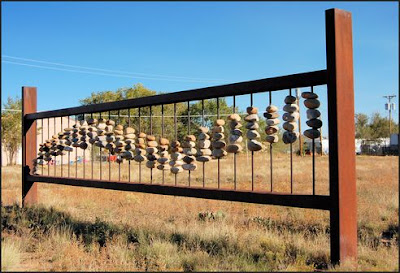


Believe me, I trampled through the weeds and gathered a bunch of burrs on my legs, socks and shoes, all for the sake of Art! I felt pricks all night, and not in the good sense! LOL!

Now to Santa Fe's lighter side, or miracle side. Wait, I should make the sign of the cross, or pour some holy water on me to cleanse me after my impure thoughts above.

This is Loretto Chapel right near the town square of Santa Fe.


This beautiful chapel was completed in 1878. Here is a photo of the altar.


The gorgeous stained glass window at the back of the church.


But what the people really come to see is the Miracle Staircase.


After the church was completed, it was realized that there was no way to access the choir loft accept by a ladder, which would take up too much space in the small church. The Sisters of the Chapel made a novena to St. Joseph, the Patron Saint of Carpenters. On the ninth and last day of prayer, a man showed up with a donkey and a toolbox looking for work. Months later, the circular staircase was completed, and the man disappeared, without the Nuns being able to pay or thank him. He was gone without a trace. The staircase has no visible means of support, two 360 degree turns, and uses no nails - only wooden pegs. Also there are 33 steps - the age of Jesus when he died. The railings were added later for safety reasons.

The second miracle actually takes place outside of Santa Fe, north about 30 miles, in the tiny town of Chimayó. At the El Santuario (The Shrine) de Chimayó to be exact.


Legend has it, back in 1810, on Good Friday, Don Bernardo Abeyta was performing penances around the hills of El Potrero. He suddenly saw a light shining from one of the slopes of the hills near the Santa Cruz River. As he neared the spot, he saw the light shining from the ground and began to dig with his bare hands. To his amazement, he found a Crucifix. He left his wonderful findings there, and went off to get some neighbors to come see the cross, and to get the priest, Fr. Alvarez. With much fanfare, Fr. Alvarez and a crowd of people arrived from Santa Cruz and carried the Crucifix in joyful procession back to the church. It was placed in the niche of the main altar.

The next day, the Crucifix was missing! Only to be found in its original spot in the dirt up in the hills. Again a procession gathered and the cross was returned to Santa Cruz. Again it was placed on the altar. And...again it disappeared. This happened three times. By then everyone understood that the Crucifix wanted to remain in Chimayó, so a small chapel was built. Quite soon afterward, miraculous healings began to happen. By 1816 the original chapel had been replaced by the current one.

There are three rooms to the church. The first one is the main room where mass is held.


photo courtesy of Elizabeth Anne VanderPutten

A smaller room runs alongside the main room. This room is filled with crutches and canes hanging from the walls, holy pictures, and rosaries. There are letters of testimonials from people describing how they have been cured by coming to El Santuario de Chimayó,

The smallest room, the Posito, or well, is reached only through the second room. The doorway is so low that you have to duck your head to enter the room. The Posito consists of just a hole in the ground, filled with the holy dirt. You can scoop up dirt to take home with you; just be sure to bring your own container. I first heard that the hole "miraculously" fills itself up, but then later read that the priest fills dirt in there every day from the hills behind the church.


Photo courtesy of www.elsantuariodechimayo.us

Each year almost 300,000 people make a pilgrimage to this tiny little Santurio; 30,000 people alone during Holy Week. El Santuario de Chimayó has been called the, "Lourdes of America".

The grounds of El Santuario de Chimayó.


And that, my friend, is my off-the-beaten-track tour of Santa Fe.

Sunday, October 18, 2009

O'Keeffe Country


Singing has always seemed to me the most perfect means of expression. It is so spontaneous. And after singing, I think the violin. Since I cannot sing, I paint. Georgia O'Keeffe


I don't know when I first fell in love with the paintings of Georgia O'Keeffe. It could have been on the many visits to the Chicago Art Institute. We were members of the Institute for several years and would go to the special exhibits at least once a year. But I was always drawn to Miss O'Keeffe's paintings. Especially this one.


Sky Above Clouds IV

This painting is huge and spans the whole wall - about 20 feet. It hangs above a stairway, and I always want to just sit there and stare at it, and just pretend that I'm flying above the clouds.

Georgia is known more for her paintings of flowers. She gets very intimate with the flower and paints with an "in-your-face" attitude. The flowers are large, and have a sensual feel to them, although I had read somewhere that she was upset that people thought that way.

I am currently reading a biography on her life called, "Full Bloom - The Art and Life of Georgia O'Keeffe" by Hunter Drohojowska-Philp. Ms. Hunter writes that Georgia had attended a private school in Sun Prairie, Wisconsin for a couple of years. In addition to her regular classes, she also took an art class. One the first day of art class, Georgia was instructed to draw, using charcoal, her interpretation of the white plaster cast of a baby's hand that sat on the table. Georgia worked hard on her piece, but the nun criticized her work saying it was too small and the lines too black. Georgia blinked back her tears. "I said to myself that I would never have that happen again,"she recalled. "I would never, never draw anything too small." That explains why we see such large close ups of flowers.


Poppies

Her paintings are vivid and colorful.


White Shell with Red, 1938

Georgia fell in love on her first trip with her sister to New Mexico in 1917. "When I got to New Mexico, that was mine." She didn't return to New Mexico until 1929, and then she returned every summer and spent some time at Ghost Ranch in Abiquiu. During her time there, she would wander the desert and the hills and get inspiration for her paintings such as:


Cow Skull with Calico Roses, 1931

She moved permanently to New Mexico in 1940.She fell in love with the landscape, the desert, the mountains, the air. She painted the mountain, Pedernal, that she viewed outside of her window several times. It was probably her favorite subject. "It's my private mountain," she frequently said. "It belongs to me. God told me if I painted it often enough I could have it." Now tell me, how could you not possibly love someone who thought like that?


Pedernal


Pedernal

Georgia also did many abstract paintings. Sometimes the colors are vibrant, sometimes they are subdued. But the paintings are ALWAYS interesting.


Blue and Green Music, 1921

One of my all time favorites of Georgia O'Keeffe's is this one.


The Lawrence Tree, 1929

She painted this at her friend, D.H. Lawrence's house. I have tried to replicate this several times with my camera - standing underneath a pine tree at night, with stars poking through the branches. It's very hard to do. I've had better luck with the photos during the day, looking up at a tall pine tree, with bits of the sky peeking through the branches.

You may ask yourself why I am giving you an art history lesson here on my blog. Well - here's why. About 8 years ago, I heard about the Georgia O'Keeffe Museum, the only art museum dedicated solely to a woman artist in the United States. That really got my attention because a) I love Georgia O'Keeffe, and b) That's quite an accomplishment. I found out the museum was located in Santa Fe, NM. I planned a small vacation all around visiting this museum (this was before we even OWNED a trailer). And my love for New Mexico was born.

Here is the museum from the outside. It's pretty nondescript. But, that's exactly how Georgia O'Keeffe was, too.


This is the third time we have been to Santa Fe, AND the third time we've visited the Georgia O'Keeffe Museum. This has been our best visit by far because it was filled with all her paintings and has a small exhibition of photos taken by her husband, Alfred Stieglitz, and other photographers. The other visits had traveling exhibitions.

We watched two short films about her life. I admire her on so many levels. Her raw talent, the way she looked at life, her feminism, just to name a few.

I stood in front of each painting and wanted to put my hand on them, just to feel something that she touched, to be one with her. My eyes welled up with tears; I was so moved by her talent, the vivid colors just jumping off of the canvas. I could just sit in front of one of her paintings and get lost in it. If I lived in the area, I know I'd become a member of the museum and visit it often!

I'm enjoying reading her biography. It's not a fast read, and I don't want to rush through it. Each night I read 5 or 6 pages, absorb them, learning a little bit more about this woman that I admire.

Georgia O'Keeffe died in 1986 at the grand old age of 98. Her ashes were spread over Pedernal Mountain. She is now one with the mountain that she loved so much, becoming part of the red dirt, her ashes picked up in the breeze that blows across the desert, her spirit free to roam the country that she loved so well.

Saturday, October 17, 2009

The Brenda Photo Challenge


Boardwalk along the Mississippi River in Vidalia, LA


This week's Brenda Photo Challenge, as suggested by Squirrel Queen (Judy) of The Road to Here is Highways and Byways. They can by roads, highways, paths, anything that can take you somewhere.

I perused my photos, and found so many different kinds. I hope you enjoy them!

This is a tri-level ramp in Albuquerque, NM. Arizona also has these huge cloverleafs. These are the only two states that I have seen the three levels of traffic. Both Arizona and New Mexico decorate their overpasses and bridges, so they are not an eyesore!


From a busy highway, we go to a dirt road. I took this on our way from Santa Fe, NM to Holbrook, AZ, so I'm not sure which state it is in.


We have driven on parts of Route 66 throughout our travels, but I've never actually just taken a photo of the road itself. Here is a mural of Route 66 that we found in Tucumcari, NM.


How about a path used by the mules to go down to the bottom of the Grand Canyon? We happened to be around when these mules and two rangers were making their way back from getting supplies. I don't think I could ride a mule all the way down the canyon!


This is a beautiful view of a walking path through the Boyce Thompson Arboretum in Arizona.


This photo was taken at the visitor's center overlooking Monument Valley on the border of Utah and Arizona. You can see how flat the land is, except for these huge rock formations. Look at the long, winding dirt road that you can drive around the monuments.


This is just one of three tunnels in Zion National Park. We had to pay to drive through one of the tunnels because of the size of our truck - even though we assured them that it was the same size as a regular truck/car. They charged us $10, stopped traffic both ways, and we had the whole tunnel to ourselves. It was quite dark in there, even with our lights on. Jim was worried our mongo side mirrors would hit the side of the tunnel. I said, "Hey, we're paying for it. Ride the center line, baby!"


This is the Natchez Trace, a 440-mile National Park, which runs from Natchez, Mississippi to Nashville, Tennessee. It runs alongside the original Natchez Trace, a worn-out path that originally started from animals walking up to Nashville for the salt licks. Later it was used by Indians, then soldiers from the Civil War. You can read all about our journey here. That's just the first day, then I have a post for each day and what we saw on the trip.


We visited the R. W. Norton Art Gallery in Shreveport, LA. It has beautiful painting and sculptures inside, and a wonderful sculpture garden outside with a pond that you can sit by. We had a chance to quickly walk the path outside, and as soon as we finished there was a downpour like you wouldn't believe!


This is a path in the Petrified Forest in Arizona. Isn't it inviting?


That's just SOME of the highways and by-ways we have traveled both by truck or foot.